Shill Market
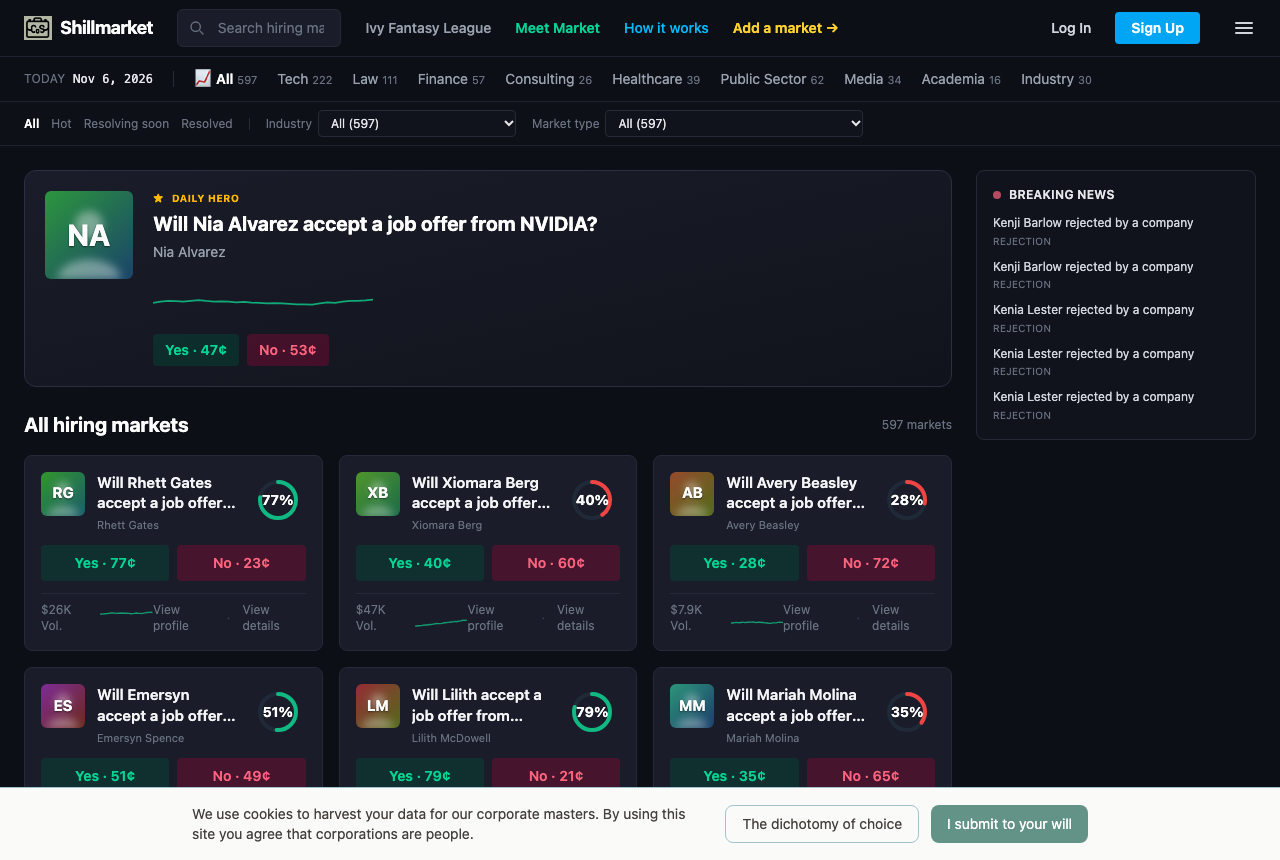
corporateshill.com is a prediction market on people's careers. Will Nia Alvarez accept a job offer from NVIDIA? Yes, 47¢. Will Rhett Gates? 77¢. Prices tick, breaking news scrolls past ("Kenji Barlow rejected by a company"), and contracts resolve when the hire is reported.
None of it is real. It's a Polymarket-shaped satire of the 2025–26 job market, populated by about 2,000 fabricated people, each with a full stream of applications, interviews, ghostings and offers. The numbers are deadpan and realistic on purpose: a median search of six to nine months, roughly 70% of applications ghosted, 200 to 500 applications to a first offer. There's no order book; it's read-only theater.
The point: what a job hunt looks like once strangers can trade on it.
If markets can price anything
The pitch for a Polymarket-type market is that a bet is information. Put money on an outcome, let the price settle, and you have a forecast better than any pundit's. The pitch never says which outcomes. If a market can price an election, it can price whether Nia Alvarez signs with NVIDIA, so Shill Market takes the idea at its word and points it at the most personal outcome there is: whether a named person gets to keep paying rent.
Look at what the material becomes. Nia at 47¢. Rhett Gates at 77¢, apparently the safer bet. "Kenji Barlow rejected by a company" is the worst email of his week, read in the voice of a sports desk with a price attached. Somebody holding No on Kenji had a good morning. Nobody on the site gloats. A rejection is a resolution event. A layoff is a catalyst. The Ivy Fantasy League bracket is the same joke: your education as a draft pick.
The realistic numbers are where it stops being funny. Six to nine months of searching, 70% of applications ghosted, a few hundred applications to a first offer: those are the plausible ones, and on a dashboard they read like fundamentals. A ticker never argues that any of this is fine. It just assumes it, in cents and in green and red, and the calm does the rest. (It also assumes somebody keeps close enough track of Nia to settle the contract, but that's a side problem.)
You can't bet. You're meant to stand there and notice how reasonable it looks. A grid of yes/no questions about whether strangers get hired, a feed of their bad news, and a cookie banner asking you to submit to its will.
The About page
Every company has an About page and every About page is the same page. This one just keeps going. It opens as thought leadership you could put in front of a board ("Agentifying Tomorrow's Synergies, Today"): stakeholder matrices, the enterprise frontier, McKinsey with the serial numbers filed off. A few screens in, the colors start to drain. By forty it's gray and the handshakes are weak. By eighty it's blood red and outdated paradigms are being annihilated at full throttle. By a hundred and twenty a man is describing his manager's cufflinks in the first person, and you realize the author has been Patrick Bateman since the first synergy. Anyone who has sat through an all-hands knows the arc; it usually takes a quarter.
It's the same voice the whole way down; it just stops pretending there's nobody in the sentence. It keeps going after the cufflinks, too. I'm not telling you where.
Nothing is fixed, either. Each visit draws its articles, headlines and sentences at random from the pools, so no two visitors should ever see the same writing in the same order. Quote a line to a coworker and they'll scroll and find a different one.



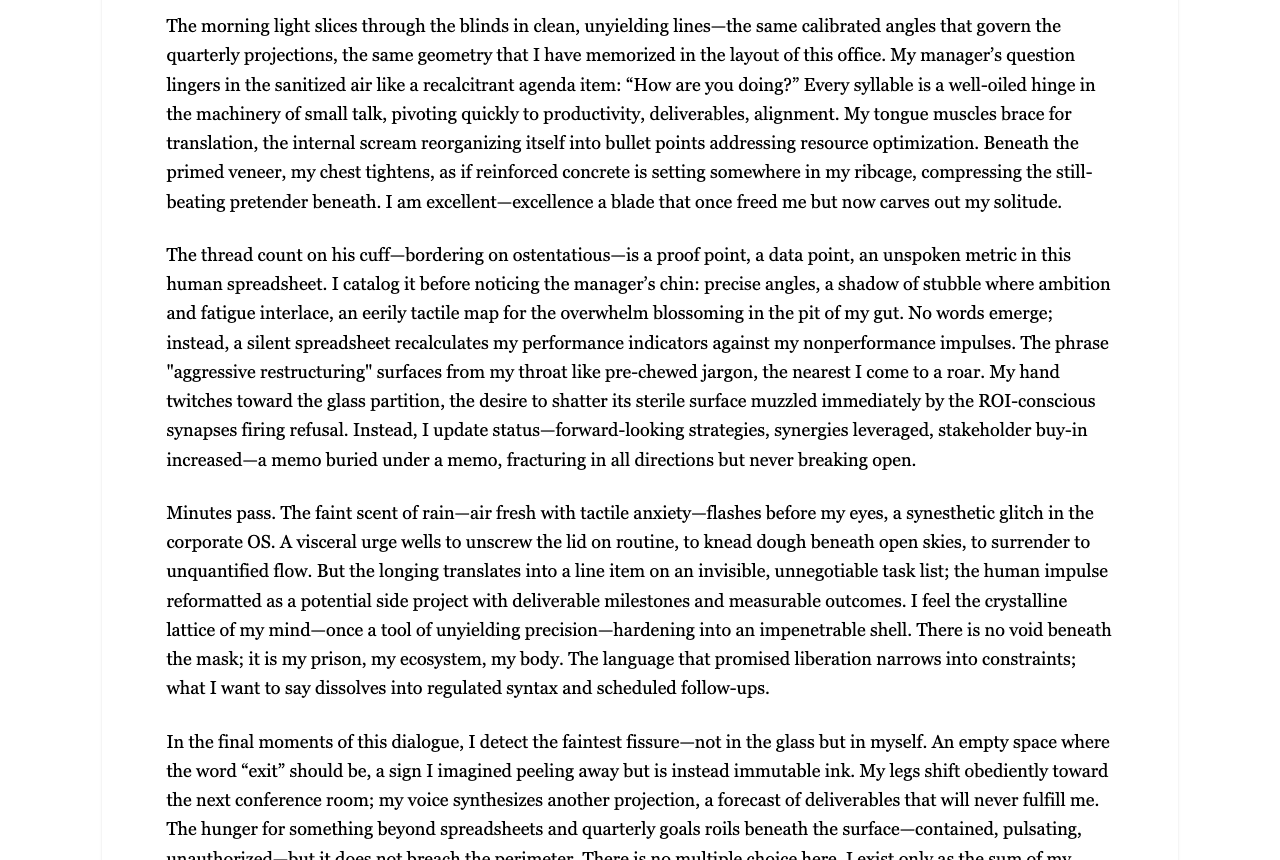
There are two versions. The About page is pure LLM output, mostly OpenAI's GPT-4.1 nano and mini with some Gemini, which I prompted in tiers from "Turbo Encabulator meets McKinsey" through cold and manic voices to fully unhinged. About 1.9 million words of articles alone (close to four times The Lord of the Rings), and about 2.7 million once you count the headlines, pull quotes and charts.
The classic edition runs the same scroll through a Markov chain instead: a blend of 2-, 3- and 4-word chains built from that same LLM text, generating fresh sentences on every visit. It strings plausible words together with no idea what they mean; a quarter get swapped for synonyms on the way out. The deepest tier still comes from the LLM, and one visit in ten to the Markov page quietly gets the LLM version anyway.
Corporate GPT
After the Markov chain I wanted to know how the real thing works, so I trained a tiny GPT from scratch on the corpus and put it in the browser. That one got its own post.
Nia Alvarez doesn't exist. Nothing about the market would change if she did.
This post was written using Claude. I am working through a backlog of posts and topics, and I don't want to keep delaying. I hope to revise this post myself and remove this comment in the near future.